
Leadership decision-making breaks under uncertainty because leaders are forced to act before clarity exists. Yet most decision frameworks are designed for stable, predictable environments, not volatile ones.
When information is incomplete, time is compressed, and consequences feel personal, the brain defaults to simplifications that feel rational but quietly degrade judgment. This is the core failure behind poor decision making under uncertainty. Not a lack of intelligence, but a mismatch between context and method.
How do leaders decide without enough data?
Leaders rarely decide with “not enough data.” They decide with the wrong type of data for the situation they’re in.
Under uncertainty, executives often
- Overweight historical metrics that no longer reflect reality
- Seek premature alignment to reduce discomfort
- Treat ambiguous problems as if they are merely complicated, not fundamentally uncertain
When leaders are making decisions with incomplete information, the instinct is to close the gap quickly. Choose, announce, move on. But uncertainty doesn’t reward speed alone. It rewards sense-making.
High-performing leaders slow the framing, not the execution. They ask
- What kind of problem is this, really?
- Is cause-and-effect knowable in advance, or only visible after action?
The quality of the decision improves not by waiting for certainty, but by choosing actions that generate information safely.
The terms and concepts underlying these capabilities are defined in The Decision Layer Lexicon.
Why does uncertainty lead to poor judgment?
Uncertainty activates threat responses. Psychological, social, and reputational.
Under pressure, leaders unconsciously
- Narrow attention to familiar patterns
- Default to authority or past success
- Confuse confidence with competence
This is why uncertainty leads to poor judgment. The brain shifts from exploration to protection. What looks like decisiveness is often defensiveness in disguise.
Data supports this. Research in behavioral decision science consistently shows that stress reduces cognitive flexibility, increases confirmation bias, and suppresses dissent. Exactly the conditions under which executive teams believe they are being “aligned.”
The danger isn’t that leaders don’t know what to do.
It’s that they stop noticing what they don’t know.
This breakdown doesn’t happen at the level of strategy or competence.
It happens at a deeper, often invisible layer where perception, emotion, and coordination interact in real time.
This is explored in depth in The Decision Layer. The Missing Skillset of 21st-Century Leaders.
What are real examples of decision-making under uncertainty?
Classic decision-making under uncertainty examples rarely involve dramatic failure at first. They start with reasonable assumptions applied too rigidly.
- A CEO doubles down on a proven growth channel while market behavior is actively shifting
- A leadership team delays action, waiting for data that can only emerge after a move is made
- An organization launches a large-scale transformation when small, contained experiments would have revealed hidden constraints
In each case, the error isn’t the decision. It’s the approach. Leaders treat uncertainty as a temporary gap to be closed, instead of a condition to be navigated.
What fails in these moments isn’t intelligence or intent.
It’s the team’s ability to notice, interpret, and coordinate under pressure. The invisible operating layer that determines decision quality.
That layer is examined in The Decision Layer. The Missing Skillset of 21st-Century Leaders.
What separates effective leaders from overwhelmed ones?
Effective leaders change how decisions are made, not just who makes them.
They
- Run multiple small probes instead of one big bet
- Reward early signals over polished forecasts
- Design decisions as learning mechanisms, not final answers
This shifts leadership from prediction to adaptation.
Under uncertainty, the strongest leaders don’t ask, “What’s the right decision?”
They ask, “What’s the next safe-to-try move that teaches us something?”
What does leadership look like when clarity doesn’t exist?
Only after this reframing does storytelling matter.
One executive I worked with described it simply
“The moment I stopped pretending we knew, my team started thinking again.”
That shift, from certainty theater to collective sense-making, changed everything. Meetings became sharper. Experiments replaced debates. Accountability increased because learning was explicit, not implied.
Uncertainty didn’t disappear. But decision quality improved because leadership stopped fighting the condition and started designing for it.
Bottom line
Decision making under uncertainty is not a leadership weakness. It’s the default state of modern leadership.
What breaks isn’t judgment.
What breaks is the illusion that control comes from having answers.
The leaders who thrive are not those who decide faster, but those who design decisions that evolve as reality reveals itself.
How your team works and decides when pressure increases
When pressure increases, the way people and teams work changes.
Information may not reach everyone at the same moment. Some things may be assumed. Some people may speak less. Others may make decisions without having the full picture.
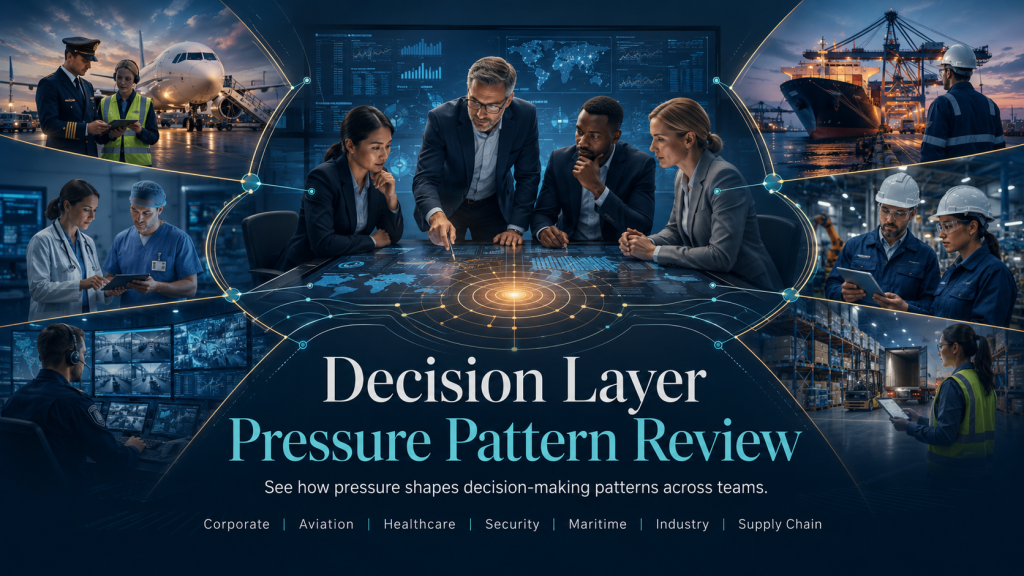
The Decision Layer Pressure Pattern Review helps you see how your own team works and decides in those moments. What it sees, what it misses, how it coordinates, how people speak, and how decisions are made when pressure rises.
It is not a test. Not an assessment. Not a diagnosis. It is a structured way to start a more useful conversation about the team you lead, coordinate, or support.