
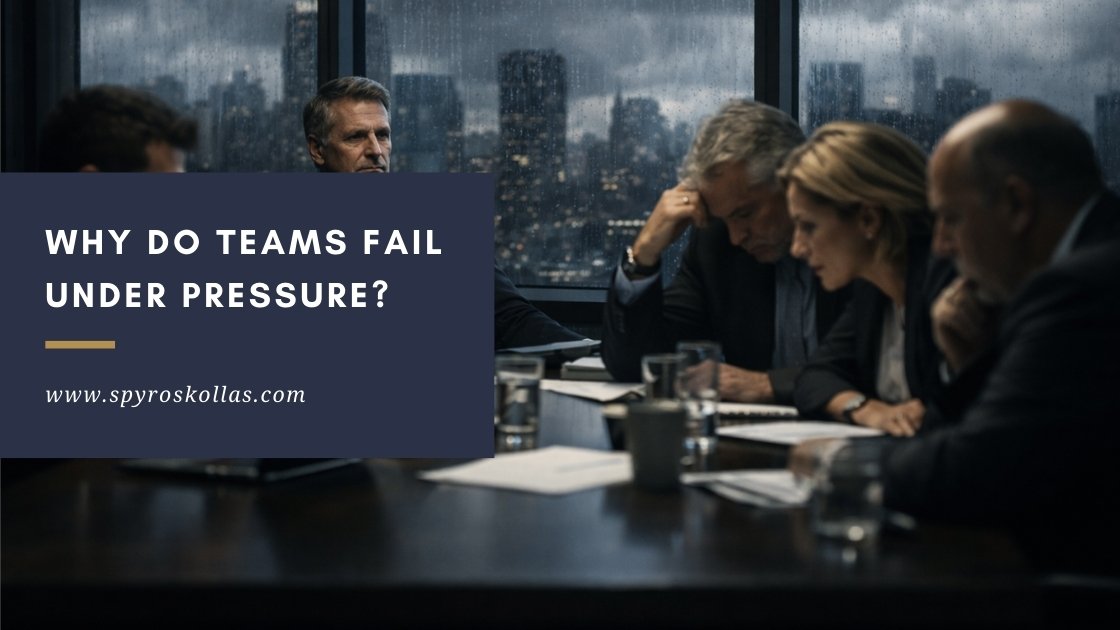
Teams make poor decisions under pressure because stress collapses shared situational intelligence, overwhelms cognitive capacity, and forces groups to act from fragmented perceptions rather than aligned judgment.
What looks like a skills problem is usually a Decision Layer failure. The invisible space where perception, meaning, and choice should align, but instead break down.
Why do teams fail under pressure?
Teams fail under pressure not because they lack expertise, but because pressure changes how expertise is accessed and integrated.
Under stress, decision making under pressure shifts from deliberate reasoning to rapid pattern-matching. Individuals revert to what feels immediately relevant, familiar, or defensible. In executive teams, this creates a paradox. More experience can actually increase blind spots, as senior leaders rely on entrenched mental models instead of real-time signals.
The result is not chaos. It’s false coherence. Meetings move fast. Consensus appears strong. But critical signals never enter the conversation because no one sees the whole situation clearly.
This is why teams make bad decisions under pressure even when everyone in the room is smart.
How does stress affect team decisions?
Stress narrows perception before it degrades logic.
At an individual level, stress and decision making are linked through cognitive overload. Working memory shrinks. Attention becomes selective. Decision fatigue sets in faster. But at a team level, the damage compounds.
Each member brings a partial picture shaped by their role, incentives, and emotional state. Under calm conditions, teams can integrate these perspectives. Under pressure, they don’t. They default to hierarchy, speed, or the loudest signal.
This is team decision making under stress. Not wrong thinking, but incomplete sense-making.
Research consistently shows that under high stress, groups.
- Miss weak signals
- Overweight recent or emotionally charged data
- Suppress dissent unintentionally
- Confuse alignment with accuracy
Executives often ask why smart teams miss warning signals. The answer is simple and uncomfortable. No one is holding the shared perceptual frame.
Why do smart teams miss warning signals?
Because warning signals rarely arrive as clear problems. They arrive as anomalies.
Under pressure, anomalies feel like distractions. Teams prioritize action over interpretation. The Decision Layer collapses, and the organization moves straight from stimulus to response.
The Decision Layer is the cognitive space between information and action where teams
- Align on what is actually happening
- Distinguish noise from signal
- Build shared situational intelligence
- Decide not just fast, but well
Most leadership models focus on execution, communication, or strategy. Few address perception under pressure, the precursor to all three.
Without an intentional Decision Layer, teams don’t decide together. They decide in parallel.
What does poor decision making under pressure look like in practice?
Consider a familiar making decisions under pressure example.
A leadership team faces declining performance. Data dashboards show mixed signals. Sales blames product. Product blames operations. Operations blames market conditions. Under pressure, the CEO pushes for speed.
The team agrees on a restructuring plan within days.
Six months later, performance hasn’t improved. The real issue? A breakdown in customer feedback loops. Was visible early, but never surfaced. Not because no one knew, but because no one integrated the knowledge.
This is organizational performance erosion driven by perceptual fragmentation, not incompetence.
How can executive teams improve decision making under pressure?
Improving decision making under pressure starts by designing for cognition, not just process.
High-performing executive teams deliberately strengthen the Decision Layer by
- Slowing perception before accelerating action
- Making assumptions explicit under stress
- Creating shared language for uncertainty
- Separating sense-making from decision-making moments
They treat shared situational intelligence as a leadership capability, not a byproduct of meetings.
Most importantly, they recognize that pressure doesn’t reveal character—it reveals cognitive design.
In the end, the question isn’t whether your team can decide fast.
It’s whether, under pressure, your team is still deciding from the same reality.
That is the real test of leadership.